

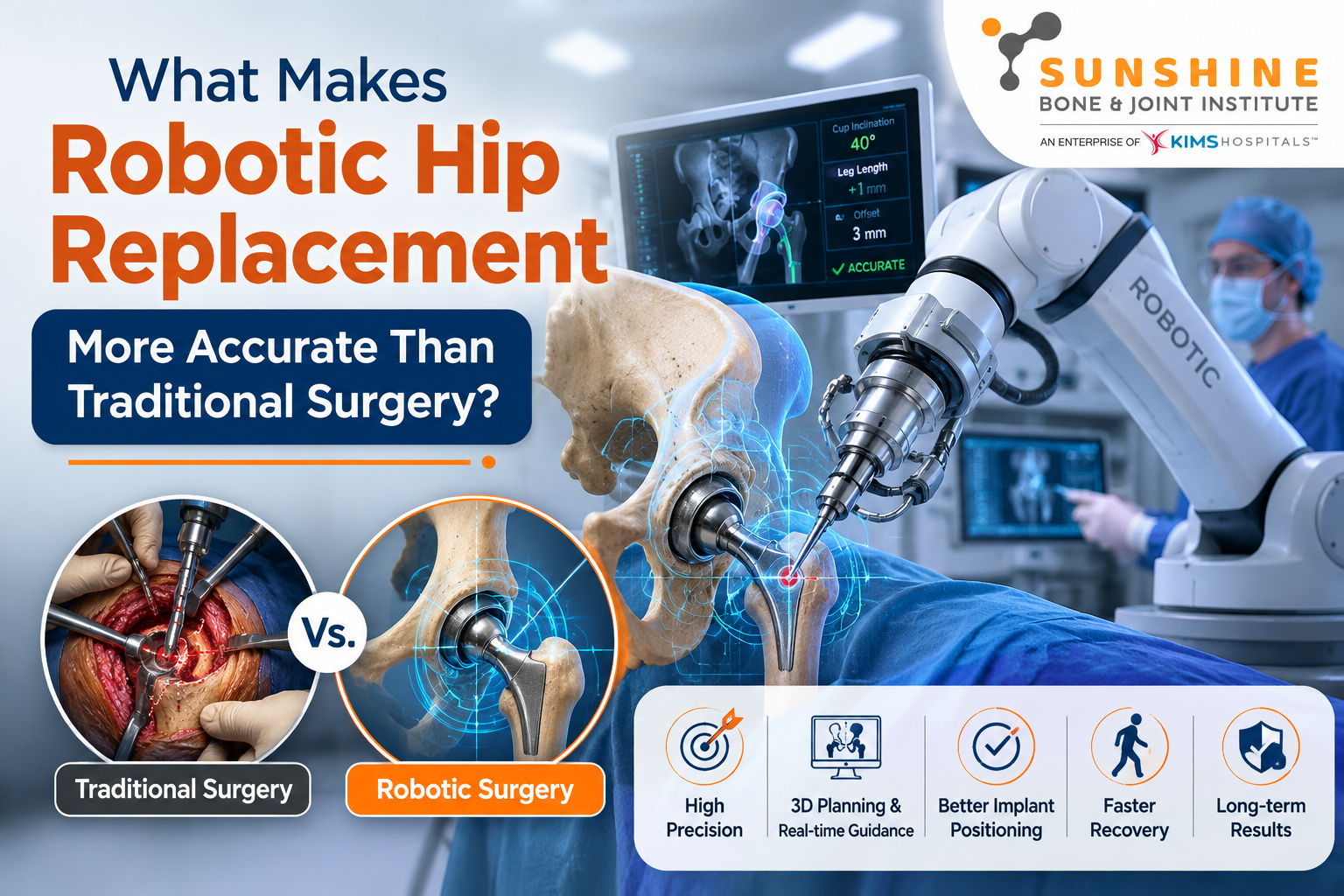
What Makes Robotic Hip Replacement More Accurate Than Traditional Surgery?
Chronic joint pain is a very common symptom, yes, but it can reduce quality of life significantly and zap your will to live very soon. Knee pain does not exist alone- it brings along friends like stiffness, poor range of motion, swelling, inflammation and tenderness. Most people respond well to conventional treatments like physiotherapy, painkillers, steroid injections or a combination of these approaches.
But what happens when they don’t work anymore? Joint replacement surgery may be your only viable option. How do you choose between Robotic Hip Replacement in Hyderabad and manual joint replacement surgery? Read on to understand what the options are and talk to your doctor about your options and preferences.
What Is Traditional Knee Replacement Surgery?
Surgeons do the whole procedure manually- with conventional instruments to cut and remove bone and cartilage that is severely damaged. They then insert the prosthetic implant carefully, at the right angle, so it is not too tight or loose and can continue to move naturally after recovery.
Experienced surgeons achieve excellent results with this approach – as they gain more experience about joint alignment and physics. But human hands may shake, have tremors or may not be able to provide the millimetre precision needed to make the real difference between a joint that takes and one that may need to be replaced again in a few years.
What Is Robotic Orthopedic Surgery in Hyderabad?
Contrary to what people assume or will tell you, a robotic arm is only as good as the surgeon who uses it to operate on you- it is highly specialized and advanced, yes, but it is still a tool! It never moves on its own. Let us look at how robotic joint replacement in Hyderabad works-
- High resolution CT scans are taken and then used to construct a 3D model of the patient’s joint- complete with its unique anatomy and other quirks. This allows the surgeon to understand where the actual incisions need to be made, how much bone and cartilage needs to be removed, the size of the implant needed and how it needs to be placed accurately for the best long term results.
- During the procedure itself, real time imaging and feedback can tell the surgeon if any adjustments need to be made. Smaller incisions mean minimal scarring and bleeding.
- Surrounding tissue is not touched or manipulated, so there is less pain, inflammation and swelling during recovery.
Main Differences Between Manual and Robotic Joint Replacement in Hyderabad-
Manual joint replacement uses rods and screws to align the joint properly. On the other hand, Advanced Hip Replacement Technology in Hyderabad at SBJI ensures that there is precision down to a fraction of a millimeter- with respect to the prosthetic implant. This means the joint works better and stays longer in your body.
Robotic Minimally Invasive Hip Replacement in Hyderabad offers different grades of feedback when working with different tissue- like bone, muscle, cartilage or connective tissue, nerves etc. This means doctors will not damage any tissue unwittingly, due to this precise property.
Advantages Of Hip Replacement Surgery in Hyderabad-
The hip, knee, shoulder or any other damaged joint can be dealt with surgically, using a robotic arm. This type of surgery promises a shorter hospital stay, low chances of complications, better joint function and range of motion and minimal scarring.
Conclusion– The decision to opt for robotic or manual joint replacement surgery is done by your doctor- after looking at your health parameters, symptoms, their severity and what you expect to do after recovery. Most prosthetic implants work well for about 20 years or longer, provided you take good care of them. Talk to our specialists to learn more about how to stay pain free and improve joint stability and function in the long term.
Call us today : +91 8008 102 103
Frequently Asked Questions
Robotic hip replacement uses advanced imaging and computer-guided planning to create a detailed map of the patient’s anatomy before surgery. This allows the surgeon to position implants with greater precision, optimise alignment, and restore joint mechanics more accurately than traditional techniques that rely primarily on manual measurements and visual assessment.
Accurate implant positioning helps ensure proper joint movement, stability, and leg length restoration after surgery. Poor alignment can increase wear, reduce implant longevity, and affect mobility. Robotic assistance provides real-time guidance during the procedure, helping surgeons achieve precise placement that supports better long-term function and performance.
Robotic technology helps surgeons plan and execute the procedure with greater precision, which can reduce the risk of implant misalignment, leg length discrepancies, and joint instability. Accurate placement supports smoother joint movement and may lower the likelihood of complications that could affect recovery or require additional treatment.
Accurate implant placement can contribute to improved joint function, stability, and movement after surgery. By helping restore natural hip mechanics, robotic-assisted procedures may support more efficient rehabilitation and better functional outcomes. Recovery speed also depends on factors such as overall health, physiotherapy participation, and surgical technique.
No. The procedure is performed by an orthopaedic surgeon who remains in control throughout the operation. The robotic system serves as a highly advanced surgical tool that provides planning data, real-time feedback, and precision guidance. The surgeon uses this information to make informed decisions and execute the procedure accurately.