

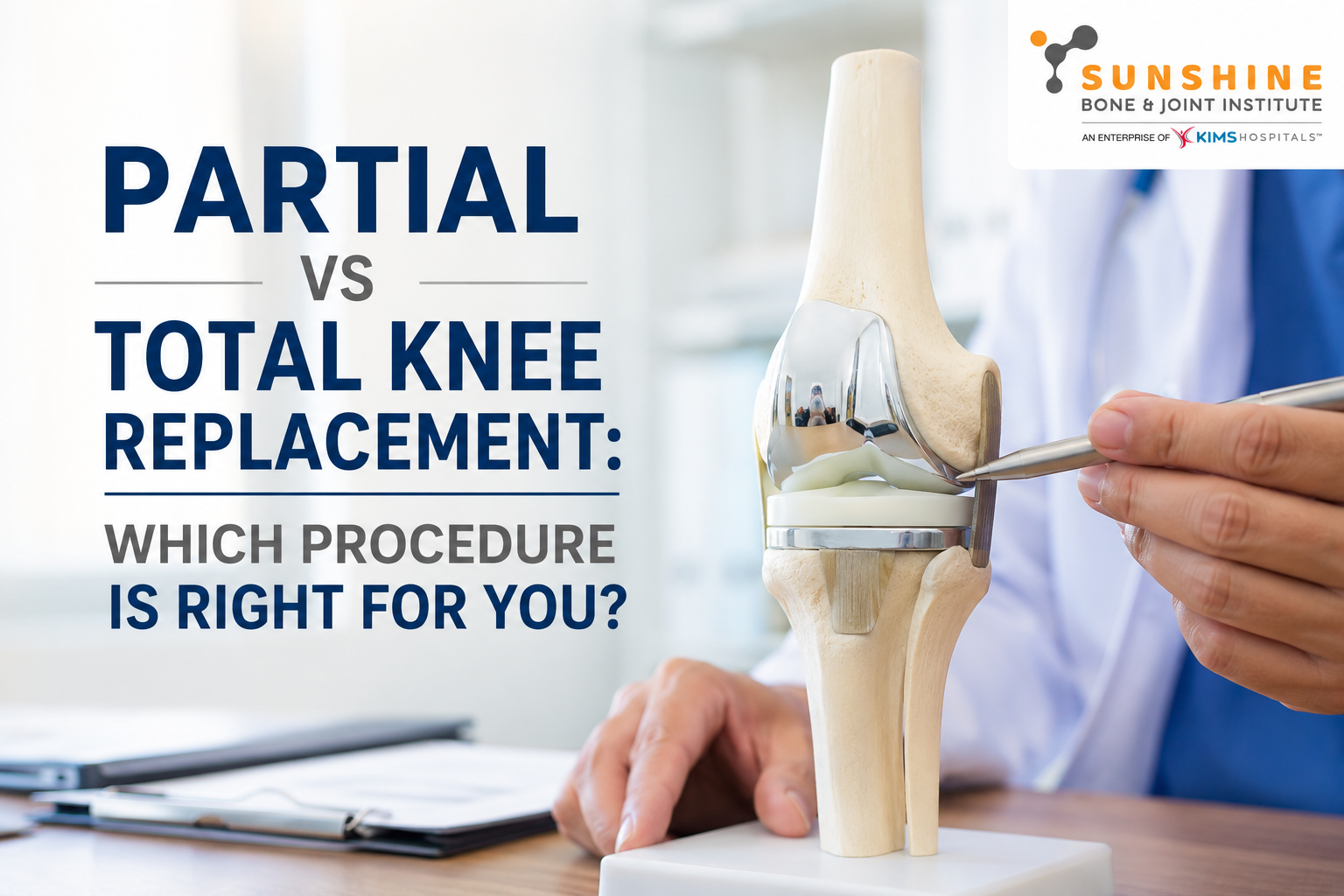
Partial vs Total Knee Replacement: Which Procedure Is Right for You?
Orthopedic concerns affect millions of individuals worldwide and the estimate is only going to increase, as people will continue to grow older and live for longer than ever. The use of surgery to address such chronic pain, stiffness and other poor joint function issues is reached, only after all conventional methods have failed to provide any modicum of relief. The question then is do you opt for Partial vs Total Knee Replacement In Hyderabad, at SBJI Hospital.
This is the question we address below.Call us if you have chronic pain, stiffness, poor range of motion and other problems today, without any delay.
Who Can Get A Partial Knee Replacement In Hyderabad?
The knee has 3 main compartments – the medical compartment on the inside of the knee, lateral compartment which is the outside of the knee and the patellofemoral compartment – which is the part where the kneecap is present in the trochlear groove. Partial knee replacement (PKR) is also called unicompartmental knee arthroplasty and this procedure is done when damage to the knee joint is highly localised and hence limited to one area or compartment.
This procedure is generally less invasive and the healthy parts of the native joint are retained. You also recover faster and preserve more natural movement and joint feel in the process.
Who Needs A Total Knee Replacement In Hyderabad?
Total knee replacement (TKR) or arthroplasty is a more invasive procedure and the whole knee joint is surgically removed, so that a new implant can be inserted. This procedure is recommended for individuals with extensive damage to the joint due to arthritis or traumatic accidents, where it makes no sense to salvage any part of the native joint.
Opting for this surgery from the Best Orthopaedic Hospital Hyderabad means you may have a keyhole or open knee surgery- depending on which method you qualify for. If the damage is very severe, then open surgery is normally preferred. But, recovery takes more time as there is more blood loss, more inflammation, swelling due to surrounding tissue being manipulated during the procedure.
Advantages and Disadvantages of PKR vs. TKR-
TKR means you will have a new joint lasting for 15-20 years or even longer. You can get back to your normal routine but will need to stick to exercises or activities that don’t stress the new joint as much. TKR is for people who have not had a good response to conservative treatments and their quality of life has deteriorated significantly due to chronic pain and stiffness. But you will take at least 4-6 months or longer to make a complete recovery.
With PKR, you may get back on your feet much faster- 6-8 weeks or even less in some cases. Quicker recovery is also bolstered when you stick to your physiotherapy regimen closely, eat well, drink enough fluids and don’t sit in one place for too long. Using ice packs, painkillers, elevating the affected knee- all can help reduce inflammation and swelling and promote recovery.
Recovery and Rehabilitation After PKR or TKR-
Your recovery timeline is unique to you and it will generally look like this-
- A couple days or longer in the hospital for you to rest after surgery and so the doctors can monitor you and get you to start walking or moving slowly.
- Using crutches, walkers or canes can help with walking in the initial days.
- Physiotherapy is important- These exercises will help strengthen your muscles, gain strength and flexibility.
- Generally, PKR patients recover much faster than individuals who got a TKR done.
Conclusion– Recovery depends on factors like your age, if you have comorbid conditions, the severity of damage to the joint, how well you stick to the recovery and rehabilitation regimen, among other factors. The best thing you can do while recovering is be patient and not compare yourself to another person and how much sooner or later they may have recovered.
If you have any concerns, please call us at +91 8008102103, as we are the best orthopedic hospital in Hyderabad.
Frequently Asked Questions
Partial knee replacement replaces only the damaged compartment of the knee while preserving healthy bone, cartilage, and ligaments. Total knee replacement replaces the entire knee joint when arthritis or joint damage affects multiple compartments.
Partial knee replacement is suitable for patients whose arthritis is limited to one compartment of the knee, with healthy ligaments and good knee stability. A detailed clinical examination and imaging studies help determine whether this procedure is appropriate.
Total knee replacement is recommended when arthritis or joint damage affects most or all compartments of the knee, causing persistent pain, stiffness, and difficulty performing daily activities despite non-surgical treatment.
Many patients recover more quickly after partial knee replacement because the procedure preserves more of the natural knee structures. Recovery, however, depends on factors such as overall health, rehabilitation, and adherence to the prescribed physiotherapy program.
The choice depends on the extent of joint damage, knee stability, age, activity level, and overall health. An orthopedic surgeon will evaluate your symptoms, perform a physical examination, review imaging studies, and recommend the procedure that best matches your condition.