

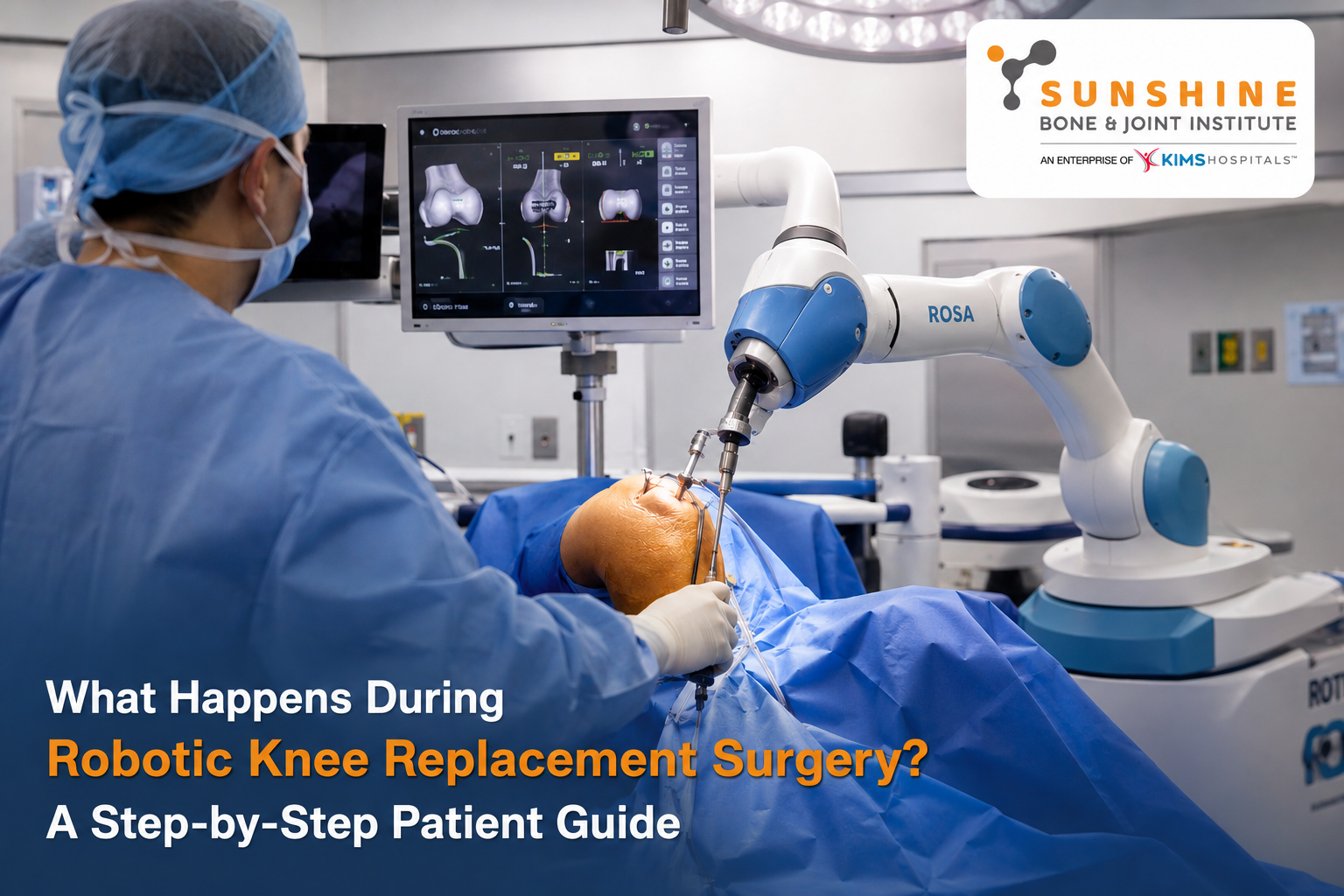
What Happens During Robotic Knee Replacement Surgery? A Step-by-Step Patient Guide
Chronic arthritis is normally shrugged off as a symptom of old age. But what happens when your joints don’t respond to conventional, non-invasive methods of treatment? You can’t expect to go on living with severe pain for the next couple decades or so. This is when you may need to think about opting for knee replacement surgery.
With great strides being made in improving surgical care and precision, it makes sense to learn more about Robotic Knee Replacement Surgery In Hyderabad. So, here is a step-by-step guide to how robotic knee replacement surgery is performed at SBJI Hospital.
What is Robotic Knee Replacement Surgery?
This is a specialised orthopedic procedure that involves the use of a robotic arm- which the surgeon controls and uses, while performing surgery. There is greater accuracy because the surgeon can look at the joint in real time and make changes to the approach, decide how much bone to cut, place the prosthesis at the right angle for best fit and not mess with surrounding tissue- ensuring that bleeding is minimal and inflammation and swelling are reduced post-op.
Step-By-Step Patient Guide For Robotic Knee Replacement Surgery-
You will begin with a detailed physical examination, after which diagnostic tests are done to understand the extent of joint injury and your symptoms.
- Step 1 – Imaging using CT scans is done, after which a 3D model of the joint is prepared-which allows the surgeon to understand where to make the incision, the unique anatomy of the patient and also see how and where the prosthesis must be inserted. These days, 3D printed implants are also being used, to improve implant fit and joint life in the long run.
- Step 2 – Blood tests, fasting guidelines, medication review- These are clearly discussed. You will need to stop using some medications like blood thinners for a while. Blood tests are done to check for inflammatory and infection based markers, if any. Since anaesthesia will be used, you will need to fast for a few hours before the procedure.
- Step 3 – Anesthesia and Positioning of the affected joint- Spinal or general anaesthesia is given on the day of the procedure carefully. The affected joint is then properly positioned, so the surgeon has maximum access, while also ensuring that you feel comfortable.
- Step 4 – Mapping confirmation by the robotic arm- High resolution CT scans are taken of the joint in question by the robotic arm. These are then used to construct a 3D model of your joint, so the surgeon understands how much bone to cut, where and how the prosthesis needs to be inserted – to help preserve as much natural movement as possible in the future.
- Step 5 – Bone preparation and implant placement- Damaged bone tissue is carefully incised away, along with affected cartilage. Surrounding tissue is not manipulated. The implant is then placed in the correct angle and fit is checked.
- Step 6 – Surgical wound closure and recovery- The incisions made to access the joint are carefully sutured. You are then taken to a room to recover for the next few days.
Conclusion– Arthritis does not affect everyone and that well known symptoms like joint pain, swelling and inflammation are due to other factors in play- not just age alone. Knee and hip pain are very well known triggers for prolonged discomfort and there are multiple ways to manage them and go about your routine.
We at SBJI have some of the best Robotic Knee Replacement Surgeon In Hyderabad. If you stick to physiotherapy regimen closely, you will recover faster and heal better. The exercises are designed to help your joint function better in the long term.
So, call us at +91 8008102103, we are the best Hospital For Robotic Knee Replacement In Hyderabad.
Frequently Asked Questions
Robotic knee replacement begins with preoperative imaging and surgical planning. During the procedure, the surgeon uses the robotic system to guide bone preparation and implant positioning according to the patient’s knee anatomy. The damaged joint surfaces are removed, the implants are placed, and the knee is tested for alignment, stability, and movement before closure.
No. The surgeon performs the entire knee replacement procedure. The robotic system provides real-time guidance and helps the surgeon execute the planned bone cuts and implant positioning with controlled precision. The surgeon remains responsible for every surgical decision and can modify the plan during the operation when the patient’s anatomy requires an adjustment.
Robotic knee replacement requires detailed preoperative imaging to create a three-dimensional model of the patient’s knee. A CT scan is commonly used for robotic surgical planning, although the imaging protocol depends on the robotic platform. The surgeon uses this information to plan bone preparation, implant size, alignment, and positioning before surgery.
Most patients begin standing and walking with assistance on the day of surgery or the following day, depending on their medical condition and surgical recovery. Physiotherapy begins early and focuses on knee movement, muscle activation, balance, and safe walking. Progression from a walker to a cane and independent walking depends on individual recovery.
Recovery occurs in stages. Walking and basic daily activities begin soon after surgery, while strength, flexibility, and balance improve through physiotherapy. Many patients resume routine activities within several weeks, but complete recovery can take several months. SBJI Hospital provides postoperative rehabilitation focused on restoring knee movement, strength, walking ability, and functional independence.