

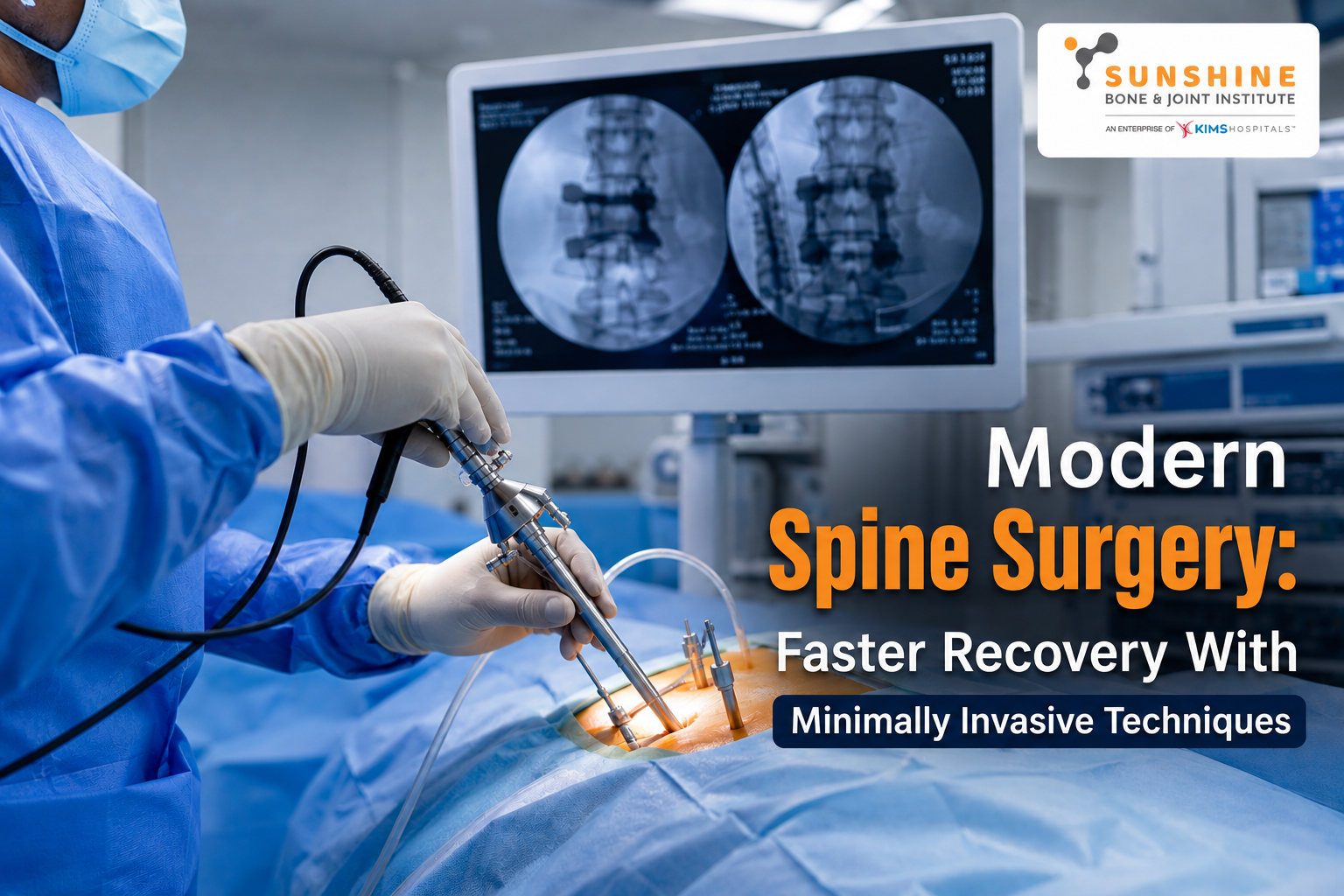
Modern Spine Surgery: Faster Recovery With Minimally Invasive Techniques
Minimally Invasive Spine Surgery (MISS) is a specialised technique that experienced surgeons use, to access the spine with tiny incisions, while surrounding soft tissue remains untouched. Spinal surgery is suggested when all other methods of symptom management have stopped working for you. MISS is normally recommended for conditions like spinal stenosis or narrowing of the spinal canal, cervical spondylosis and others, where damage to the spine is localised.
Please call us at SBJI Hospital, if you have been searching for Best Spine Surgery Hospital In Hyderabad or Spine Surgeon Near Me online and talk to us today!
What Is MISS?
Minimally Invasive Spine surgery in Hyderabad involves the use of specialised protocols that make tiny incisions on the back, through which a tube is slid in. Imaging using an endoscope can be done, while other instruments can be used to incise or repair the affected area.
Different types of procedures are possible with this approach and can hence take the form of surgeries like discectomy, spinal decompression, spinal fusion, fixation etc.
Conditions That MISS Can Treat-
Minimally Invasive Spine Surgeon In Hyderabad can help solve symptoms associated with – cervical spondylosis, herniated discs, instability of the spine, kyphosis, scoliosis, spinal stenosis, localised spinal tumours, vertebral compression fractures, degenerative disc injuries etc. among others.
Preparing for MISS-
Doctors first begin with a detailed physical exam, followed by diagnostic tests that are done to check for extent of damage, location on the spine and if the issue is localised.
- Imaging- CT, MRI or spine X-rays are done.
- Smoking cessation is necessary.
- You can continue to exercise and stretch, to help muscles work better during recovery.
- You should stop certain medications like blood thinners, antibiotics or others, which can interfere with anaesthesia or healing.
- Talk to your doctor about fasting through the night or if that is not needed.
- Arrange for someone to help you for the first few weeks after you go home, as you will need to rest well.
What Happens In MISS?
You will first be anaesthetised with local or general anesthesia before the procedure.
- Then, the doctor will make incisions or cuts through the back, chest or abdomen, depending on where the spinal issue is located.
- A tube is first inserted into the incision, followed by an endoscope or tube with a camera- this allows the surgeon to see the spine clearly.
- Specialised instruments are slid in through the metal pipe to cut away or repair tissue. Retractors are used to show more surface area, so the surgeon can see the affected area better. Surrounding tissue can then come back to normal positions, once the retractors are removed.
- The incision is then closed, after which bandages are tightly wound on the area.
Robotic Spine Surgery Using Minimally Invasive Approach-
Just like how a robotic arm is routinely used for many orthopedic procedures, their use in spinal surgery is also well understood. Doctors will let you know if the robotic arm will be used for your procedure.
There is greater precision and accuracy, less bleeding and fewer scars and lower levels of inflammation due to low soft tissue manipulation and damage.
Conclusion– Please call us at +91 8008102103 for the best Spine Specialist In Hyderabad. Our surgeons are highly experienced and can recommend the best type of approach for your specific spinal issue. Physiotherapy is necessary after surgery, for you to move better in the long term.
Frequently Asked Questions
Minimally invasive spine surgery uses smaller incisions and specialised instruments to access the spine while limiting damage to surrounding muscles and soft tissues. Depending on the condition, techniques can be used for procedures such as discectomy, decompression, or spinal fusion. The goal is to address the spinal problem while reducing tissue disruption during surgery.
Minimally invasive techniques can be used for selected patients with conditions such as herniated discs, spinal stenosis, degenerative disc disease, spondylolisthesis, and certain spinal fractures. The appropriate procedure depends on the location and severity of nerve compression, spinal instability, symptoms, imaging findings, and response to non-surgical treatment.
Minimally invasive surgery reduces the size of the surgical incision and limits disruption to muscles and other tissues. It can result in less postoperative pain, lower blood loss, and faster mobilisation for appropriately selected patients. Open surgery remains necessary for complex spinal conditions that require wider access for adequate decompression or reconstruction.
Recovery depends on the procedure, spinal condition, overall health, and physical demands of daily activities. Patients can begin mobilisation soon after many minimally invasive procedures. Light activities may resume within days or weeks, while strenuous exercise, heavy lifting, and physically demanding work require a longer recovery period determined by the spine surgeon.
Modern spine surgery uses technologies such as high-resolution imaging, intraoperative navigation, specialised surgical instruments, and microscope or endoscopic visualisation. These systems help surgeons identify spinal structures, plan the surgical approach, and position implants accurately when required. At SBJI Hospital, advanced surgical techniques are used alongside clinical assessment to develop treatment plans for individual spine conditions.