

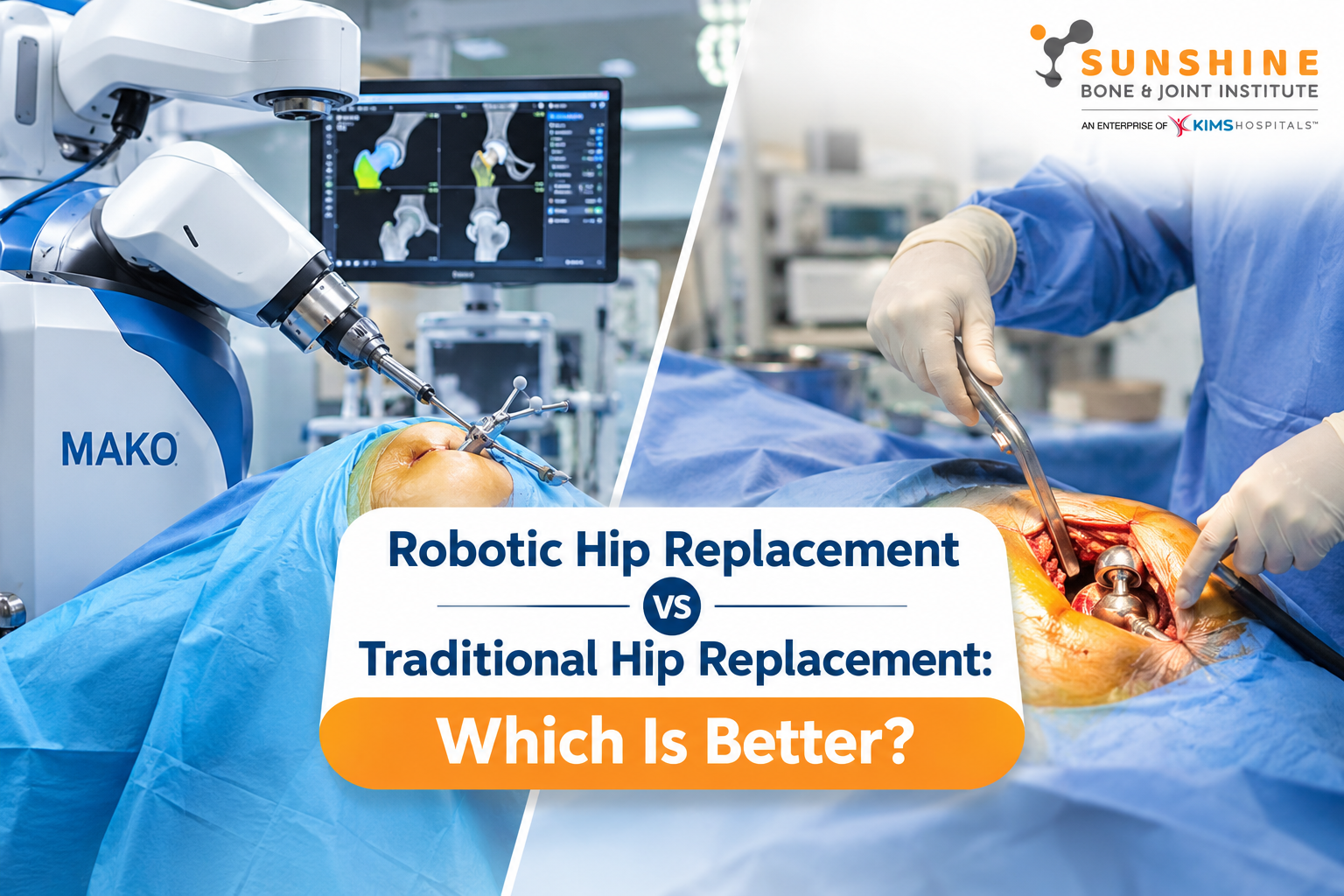
Robotic Hip Replacement vs Traditional Hip Replacement: Which Is Better?
For hundreds of millions of people suffering from arthritis, joint degeneration, and chronic hip pain, total hip replacement has meant the difference between a life limited by pain and one filled with movement, independence and possibility. Thanks to advances in medical technology, hip replacement is one of modern medicine’s greatest success stories.
Robotic Hip Replacement in Hyderabad
Hip replacement surgery, also known as hip arthroplasty, is done only when pain doesn’t improve with non-surgical treatments, such as, anti-inflammatory medications, physical therapy, or assistive devices. The hip joint consists of 2 components – head of the thigh bone, the ball and the hollow space in the hip bone, the socket. This surgery involves the removal of the damaged portion of the hip joint – the ball, socket or both and replacing them with prosthetics, made out of metal, ceramic or hard plastic. The prosthetic addition addresses the patient’s symptoms and restores joint functionality, helping them perform their daily activities with more ease.
Hip Replacement Surgery In Hyderabad
The fundamental difference between traditional and robotic surgery lies in the surgical planning and execution, which in turn has a direct impact on surgical efficiency and patient recovery. Understanding these differences can help patients make informed decisions about their treatment.
What is Traditional Hip Replacement?
Traditional total hip replacement surgery is the gold standard used by surgeons, where the chief surgeon relies solely on X‑rays and their prior surgical experience to remove diseased bone and align the implant. This method involves the usage of manual cutting guides, anatomical landmarks and visual judgement to navigate during the surgery. They use specialized instruments to remove damaged bone and cartilage tissue from the femur and pelvis.
Even though this method has helped millions to get on with their life afterwards, surgeon hands have limitations when compared with modern robotic systems that map each patient’s anatomy and guide placement with super‑human precision.
What Is Robotic Hip Replacement?
Robotic hip replacement is not a surgery performed by a robot alone; instead, the orthopedic surgeons uses advanced technology to great effect. This essentially means that the surgeon will still perform the incision and make all of the soft tissue cuts, and the robot helps the surgeon navigate precisely, improving surgical accuracy.
So here is how the robotic system works:
- Firstly, the surgeon uses a patient’s prior X-rays or high resolution CT scans to create a 3D model, which helps to determine the exact size, placement and alignment of the prosthesis before surgery.
- Next, the surgeon gets feedback from the robotic system regarding the prosthetic placement or alignment during the surgery, which allows the surgeon to adapt and perform the surgery efficiently in real-time.
- By the end of the surgery, the surgeon removes only the diseased bone, preserving the healthy bone and soft tissue nearby and not manipulating them- reducing inflammation and associated issues greatly.
Robotic vs. Traditional Hip Replacement: Key Differences-
| Step | CT-planned robotic replacement | Conventional replacement |
| Pre-operative imaging | Dedicated CT of pelvis, hip and knee, sometimes with standing and seated X-rays | Standing pelvic and hip X-rays |
| Planning method | 3D digital model with virtual implant placement and predicted leg length and offset | 2Dl X-rays |
| In the OT | Bone registered to the model with tracked pins; robotic arm constrains reaming and cup angle | Surgeon uses anatomical landmarks, alignment guides and experience |
| Extra steps | Pin sites in bone, registration time, possible conversion to conventional technique | No additional |
| Anaesthesia, incision | Same as conventional | Same as robotic |
| Recovery pathway | Faster, most patients walk within 24 hours | Longer recovery, mobilisation takes more time |
| Post-op pain | Less pain due to minimal tissue trauma | More post-operative pain and swelling |
| Physiotherapy | Often shorter course needed | More intensive and longer course required |
| Implant Longevity | Higher, more precise alignment reduces wear | Greater risk of early wear if alignment is off |
Conclusion
The sole aim of the hip replacement surgery, whether it is traditional or robot-assisted, is to replace the damaged portion of the hip joint with prosthesis, thereby relieving pain and restoring mobility. However, the extent of joint damage, patient’s overall health and equipment availability play a crucial role in deciding the surgical method.
Traditional surgery heavily relies on manual precision and the surgeon having years of experience. Robot-assisted surgery serves as a tool that builds on the surgeon’s experience to place and align the prosthesis accurately. Therefore, it is important that patients understand both methods to make a confident and informed decision about their care. So, schedule a consultation with one of our surgeons and check which treatment route would be the best fit for you. Call us at +91 8008102103 today to learn more!
Frequently Asked Questions
People with mild arthritis that is manageable without surgery, an active infection anywhere in the body or people who continue to smoke are usually asked to wait or optimise first. The final verdict of whether the patient is surgery-ready always rests with the treating team after examination and imaging.
Yes, due to the additional cutting-edge technology and preoperative planning involved.
Using a robotic aid while performing hip replacement surgery can reduce the risk of implant misalignment and leg length discrepancy. While it enhances surgical accuracy, overall safety depends on the surgeon’s experience and hospital infrastructure.
In traditional hip replacement surgeries, the plan is largely fixed once surgery begins. However, with the involvement of a robotic guide, the plan can be fine-tuned based on real-time feedback.
Most health insurance policies cover traditional hip replacement surgery. However, coverage for robotic-assisted procedures depends on the policy terms, so it is advisable to check with your individual cover and insurance provider.