
Advantages and Disadvantages of Robotic Orthopedic Surgery You Must Know
Orthopedic problems often require great finesse in diagnosis and subsequent treatment. While most individuals get better with conventional modes of treatment which are non-surgical in nature, when the problem is too severe and normal treatments offer no relief at all, it is time to consider going in for orthopaedic surgery. In India, millions of affected individuals opt for joint replacement surgery and the number is only expected to grow in the next few years. Robotic orthopedic surgery is a more recent advancement in this field and it has been developed to ensure there is greater precision and lesser recovery time for patients who get the procedure done. SBJI is the top orthopedic hospital in Hyderabad in this regard, as we have the very best specialists in the field who have undergone extensive training in the use of robotic systems, which translate to better surgical outcomes in the end.
What is Robotic Orthopedic Surgery?
Traditional orthopedic surgery is time consuming and may not be as precise, as the surgeon has a limited view of the surgical field and there is no real time feedback on how the prosthetic needs to be placed. The incision is larger too, which means recovery may take longer than usual. There is also an increased risk of bleeding or clots forming as the patient is anaesthetised for longer periods of time. If the prosthetic is not aligned in the right way, then there is the increased risk of suffering from a joint dislocation in the future.
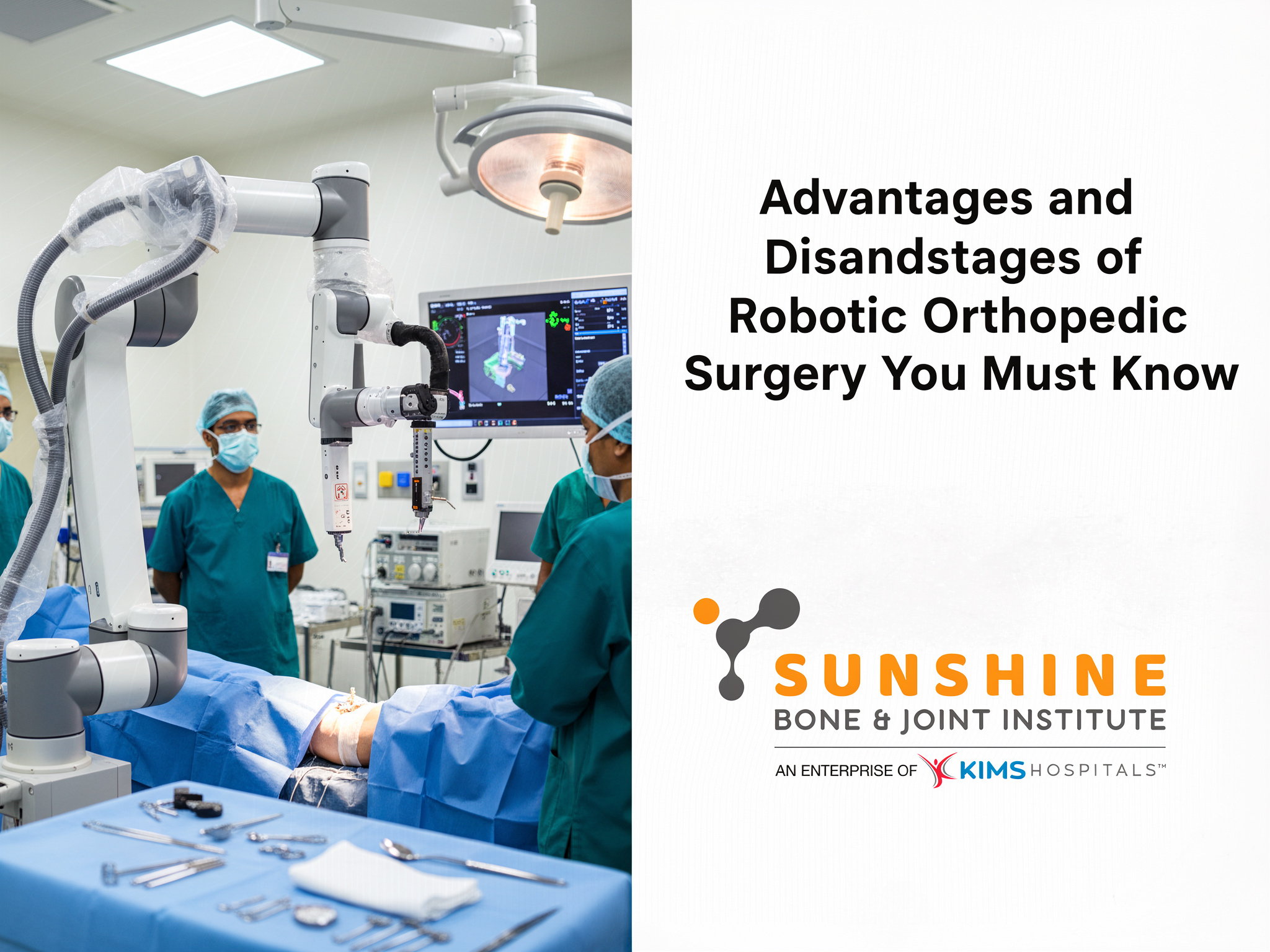
To circumvent such avoidable issues, robotic orthopedic surgery uses a robotic arm which has highly advanced software built into it. First, detailed CT scans of the affected joint are taken and then used to construct a 3D model of the patient’s joint. This is anatomically perfect and can be used to help the surgeon ascertain how much bone to cut off, remove the affected part of the joint, place the prosthetic in the right orientation and make sure there is no discrepancy in length of the limb afterwards (if the knee is being replaced); all while ensuring there is real time feedback of how much blood loss is occurring and if the surrounding soft tissue is getting damaged or not.
How Safe is Robotic Orthopedic Surgery?
Robotic surgery is very safe as an experienced surgeon handles the robotic arm to perform the procedure. The robotic arm won’t ever move on its own. If the robot is used in the right way, the patient has a smoother recovery post surgery. The margin of human error is greatly reduced, which ultimately makes the joint feel more natural to move in, after all tissues have healed.
Advantages and Disadvantages of Robotic Orthopedic Surgery-
Let us look at why robotic surgery is advantageous for orthopedic issues-
- There is greater precision with respect to where the bone is cut and how much is reamed off and this means there is better accuracy when the prosthetic joint is placed.
- The surrounding soft tissue is not damaged or moved around a lot, which means you will have less pain and soreness afterwards.
- The incisions used are much smaller in size and hence will heal and not scar too prominently.
- There is less bleeding during and after the procedure.
- Surgical outcomes are good and patients tend to recover faster, with minimal risk of complications.
There are a few important disadvantages to consider though-
- The surgeon needs to be very well trained in using the robotic arm. This means more time is spent in training itself. This is a tradeoff that many are willing to make.
- The instrument itself is expensive and is hence available only in a few hospitals, due to the high initial expenditure during procurement.
- Since it is a machine, there are chances of it breaking down or having some kind of mechanical or software failure. Though this is very minute, it is a very real problem. But, there are safeguards in place for such unexpected situations.
Conclusion– It is important to remember that robotic surgery is still surgery at the end of the day- which means the risks of bleeding, clot formation or infection are not totally absent. Plus, a smooth recovery is dependent not only on the type of procedure used, but is greatly influenced by how well you listen to your doctor. You should take painkillers, move slowly but surely and take your physiotherapy sessions very seriously. You should also never overdo any motion and strain the prosthetic in any way. During recovery, your diet and mental health also need to be taken care of, as less stress can mean a better mood too. So, if you have any orthopedic issue that needs to be taken care of, book a consultation with our specialists at SBJI, today!
Frequently Asked Questions
Robotic orthopedic surgery uses computer-assisted robotic systems to help surgeons perform procedures like joint replacements with greater precision. The surgeon remains in full control while the robot enhances accuracy and consistency.
Key advantages include improved surgical precision, better implant alignment, smaller incisions, reduced blood loss, faster recovery, and potentially longer-lasting joint replacements due to accurate positioning.
Yes. Disadvantages include higher procedure costs, limited availability, longer setup times, and dependence on advanced technology. Outcomes may also vary based on the surgeon’s experience with robotic systems.
Robotic surgery can improve accuracy and reduce human error, which may lower complication risks. However, overall safety still depends on surgeon skill, patient health, and proper system use.
Patients needing knee or hip replacements, with good bone quality and no complex deformities, are often ideal candidates. A surgeon’s evaluation is essential to determine suitability.