

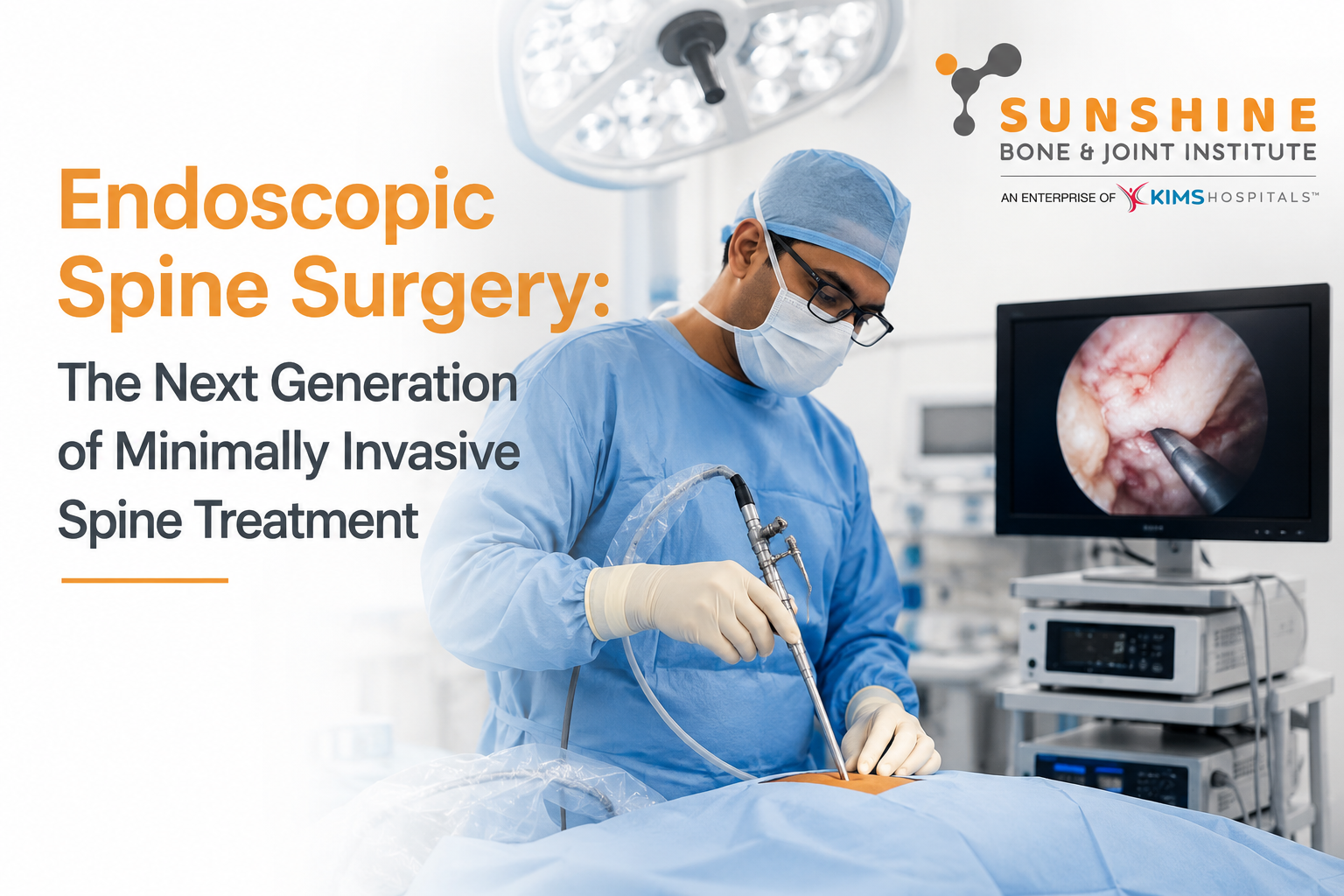
Endoscopic Spine Surgery: The Next Generation of Minimally Invasive Spine Treatment
Surgery is often the last solution individuals consider, when they are in chronic pain and their back feels stiff and hard to move. Fortunately, treatment does not need to involve highly invasive open spine surgery, with major advances being made in endoscopic back surgery in Hyderabad- at SBJI.
Let us look at what minimally invasive spine surgery (MISS) and full endoscopic spine surgery (FESS) are, what conditions they can treat and the benefits of opting for such a procedure below.
What Do MISS and FESS Mean?
The term minimally invasive can be misleading- yes, the incisions are much smaller than traditional open surgery, there may be the same amount of shifting or manipulation of surrounding soft tissue- which means your recovery will be more similar to what happens after open spine surgery. Here, the minimally invasive term exclusively stands for the size of the initial incision made, not any other aspect.
MISS and other minimally invasive techniques use tube-like retractors of varying sizes and thicknesses to stretch and retract tissue, during the procedure. The size of the retractor used is dependent on how much light is needed to work on the surgical site and which size is best to work with soft tissue. The smallest retractors are truly minimally invasive, but the surgeon needs a lot of experience to work with them.
FESS or full endoscopic spine surgery uses retractors or tubes which are 3-10mm in size and very small incisions. A tube fitted with a high definition camera called the endoscope is inserted via the incision and into the spine. Specialised instruments are then sent in to cut any worn out bone or tissue.
Conditions Treated With MISS-
Degenerative conditions like kyphosis, scoliosis, vertebral compression fractures, spinal tumour decompression, herniated disc repair and spinal fusion surgery respectively.
Conditions Treated With FESS-
Some of the most common conditions that can be treated by FESS include-
- Disc issues- when it is herniated, prolapsed or protrudes out of the spinal column.
- Recurrent disc herniations
- When the spine is affected by degenerative disease.
- Spinal stenosis or narrowing of the spinal canal due to aging.
- If the disc is torn or damaged in any way – called annular tears.
- Pain that strikes after a failed spinal surgery.
There are a lot of other conditions, most of which can cause nerve compression and cause unwanted neuropathy and pain. If you have been diagnosed with a slip disc or sciatica, then please walk in to SBJI today, to opt for personalised slip disc and sciatica treatment in Hyderabad.
Advantages Of Endoscopic Spine Surgery in Hyderabad-
FESS is very useful in older adults dealing with all kinds of disc related issues. Since surrounding tissue is not manipulated as much, individuals recover faster and get back to their routines sooner. There is lesser dependency on pain medications too.
Conclusion– Chronic back pain can mess with your quality of life and make even the simplest tasks hard to finish. If you want to feel better, please get in touch with our specialists to understand which technique will be the best option for you.
Call us today : +91 8008 102 103
Frequently Asked Questions
Endoscopic spine surgery is a minimally invasive procedure that uses a thin tube with a camera and specialised instruments to access the spine through a small incision. The surgeon views the surgical area on a monitor and treats the affected structure with minimal disruption to surrounding muscles, ligaments, and tissues.
Traditional spine surgery often requires larger incisions and greater tissue dissection to access the spine. Endoscopic spine surgery uses small incisions and specialised instruments, allowing surgeons to reach the affected area with less tissue damage. This approach can reduce postoperative pain, blood loss, and hospital stay duration.
Endoscopic spine surgery is commonly used to treat herniated discs, spinal stenosis, nerve compression, sciatica, and certain degenerative spine conditions. The procedure aims to relieve pressure on spinal nerves while preserving normal anatomy, helping improve pain, mobility, and overall quality of life.
Benefits include smaller incisions, reduced muscle damage, lower blood loss, less postoperative pain, shorter hospital stays, and faster return to daily activities. Because the procedure preserves more healthy tissue, patients often experience improved recovery and reduced surgical trauma compared with conventional open spine surgery.
Recovery time depends on the condition treated and the patient’s overall health. Many patients are able to walk on the same day or within 24 hours after surgery. Most return to routine activities within a few weeks, while full recovery and rehabilitation may take several weeks to months.