

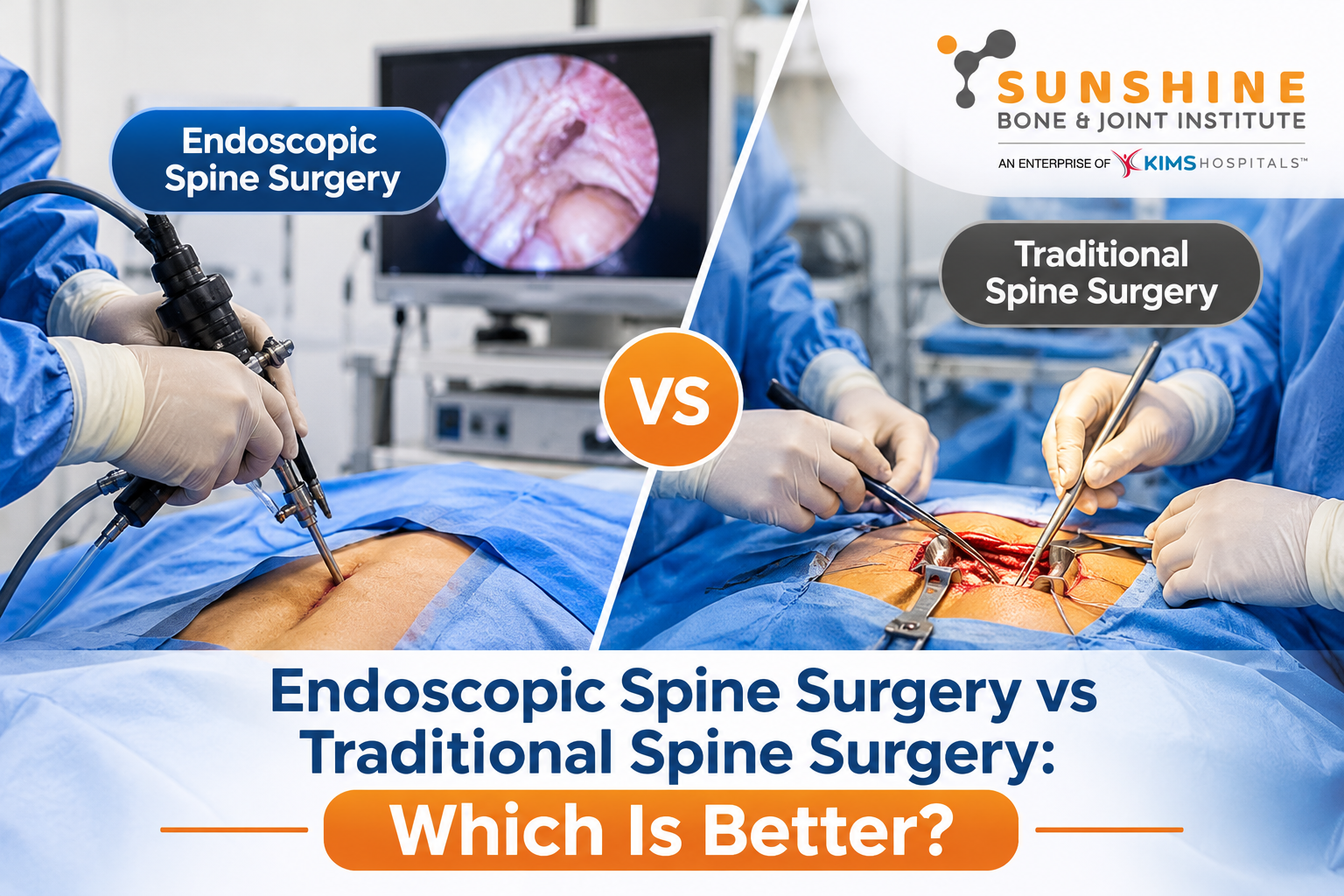
Endoscopic Spine Surgery vs Traditional Spine Surgery: Which Is Better?
The spine is a crucial structure in your back that makes sure the skull is connected to the rest of the body, while also providing a safe pathway for the thick bundles of nerves that form the spinal cord to innervate different parts of the body. The spine is made of many bones called the vertebrae and when they get injured or too worn, they can cause severe pain and press on sensitive nerve endings. When such pain or neuropathy gets worse even with treatment and refuses to get better, you may need to think of spine surgery in Hyderabad.When Is Advanced Spine Surgery in Hyderabad Necessary?
You will need spine surgery for any condition that causes nerve endings to get compressed and lose normal nerve function. Plenty of conditions like a herniated disc, fractured spine, spinal stenosis due to advancing age, spinal atrophy etc. need surgery to fix the root cause of pain and associated symptoms.What Is Endoscopic Spine Surgery in Hyderabad?
Endoscopic surgery is a type of Minimally Invasive Spine Surgery in Hyderabad – where tiny incisions are made on the skin. The surgeon then inserts specialized instruments through a tube called the endoscope, including a camera that allows real time visualisation of what is happening at the spine. Inflamed tissue that is pressing down on the nerves is removed or excised away. This is a good option if damage is highly localised. You also recover much sooner, as there is lower blood loss and surrounding tissue stays as is, reducing inflammation and swelling.What is Traditional Spine Surgery?
For more complex cases or when there are more than 1-2 regions of the spine that are affected, traditional open surgery is best. Here, a large incision is made along the spine, muscles and connective tissue are gently moved aside and then access to the spine – vertebrae and discs is possible. There is more blood loss and risk of infection and reaction to anesthesia is greater, as the procedure takes more time. The incision site needs to be carefully looked after post-surgery. You will spend more time doing physiotherapy and rehabilitation of the spine overall.Endoscopic Spine Surgery vs Open Surgery –
Let us look at both types of procedures in detail below-| Comparison Factor | Endoscopic Spine Surgery | Traditional Spine Surgery |
| Surgical approach | A thin endoscope (tube like structure), camera and specialised instruments are inserted through a small incision. | A larger/longer incision is used to access the affected spinal structures directly. |
| Incision size | One small incision is made. | A large incision is made. |
| Muscle disruption | Surrounding muscles are not manipulated. | Muscle tissue is retracted or moved and even dissected where necessary. |
| Blood loss | Low | High |
| Postoperative pain | Less inflammation and pain as muscle and connective tissue are not touched. | Greater levels of discomfort, swelling and inflammation as tissue is manipulated. |
| Hospital stay | Short – 1–2 days at the most. | A few days to weeks, based on the complexity of the procedure. |
| Recovery time | A few weeks. | Many weeks and months, especially if spinal fusion is involved. |
| Suitable conditions | For localised herniated discs, nerve compression and certain types of spinal stenosis. | Examples include complex spinal stenosis, deformities, instability and cases requiring spinal fusion. |
| Limitations | The camera can visualise only a small region, so more widespread conditions cannot be treated. | More post-surgery pain, swelling and inflammation, larger scar, protracted recovery period. |
Which Is Better?
This is not the right question to ask- as each procedure is good for a specific set of conditions. Call our spine specialists at SBJI Hospital to understand which type would work for you, why and how recovery will look like- both in the short and long term. Schedule an appointment today!Frequently Asked Questions
Endoscopic spine surgery uses a small incision, a thin camera and specialised instruments to access the affected spinal area. Traditional spine surgery generally involves a larger incision and greater muscle dissection to reach the spine. The choice depends on the spinal condition, affected levels and the procedure required to achieve adequate nerve decompression or spinal stability.
Endoscopic spine surgery uses smaller incisions and causes less disruption to surrounding muscles than many open procedures. This can reduce blood loss, postoperative pain and wound-related complications. However, both approaches carry risks, including infection, nerve injury and bleeding. The surgeon selects the technique based on the patient’s diagnosis, anatomy and surgical requirements.
Patients with selected conditions, such as lumbar disc herniation and spinal stenosis, may be candidates for endoscopic spine surgery. Suitability depends on MRI findings, symptom severity, spinal stability and response to non-surgical treatment. Patients with significant deformity, instability or complex spinal disease may require traditional surgery or another surgical approach.
Recovery depends on the spinal condition, procedure and patient’s overall health. Many patients undergoing endoscopic procedures resume light activities within days and gradually increase activity over the following weeks. Traditional spine surgery may require a longer hospital stay and rehabilitation period. Heavy lifting, strenuous exercise and driving should resume only after the surgeon’s clearance.
The choice between Endoscopic Spine Surgery vs Open Surgery depends on the location and extent of nerve compression, spinal stability and the need for reconstruction or fusion. An experienced spine surgeon reviews clinical findings and imaging before recommending a procedure. At SBJI Hospital, patients can discuss the benefits, risks and expected recovery of each approach.