

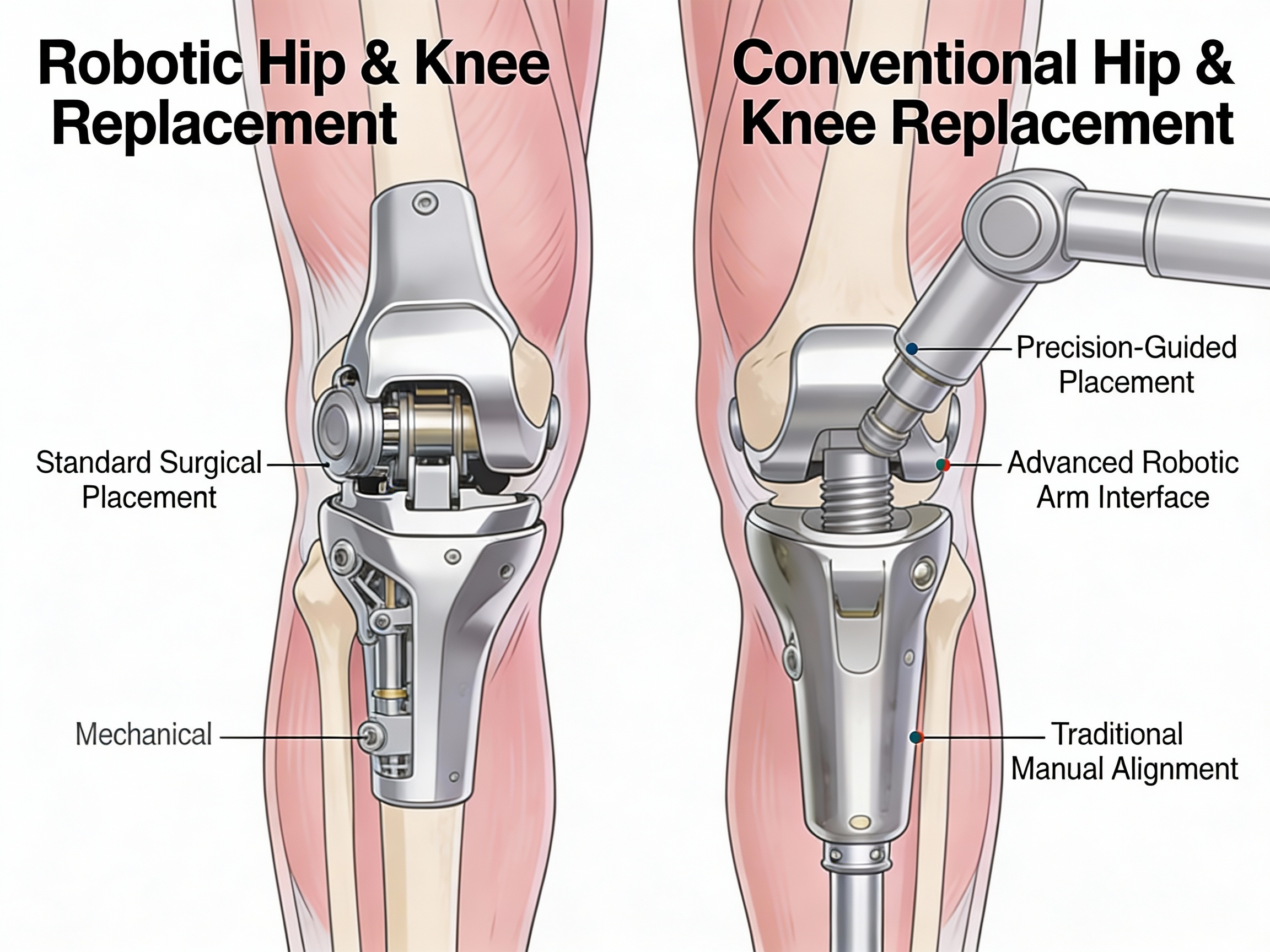
Robotic vs Conventional Hip & Knee Replacement: Which One Should You Choose?
Chronic joint pain- especially of the knee and the hip can be debilitating and hard to deal with on a daily basis, as it can affect quality of life severely if not addressed promptly. Joint replacement surgery is only recommended when all other conventional modes of treatment have been seen to have no effect on symptoms. Knee replacement can be of two types- conventional and robotic. Conventional joint replacement surgery has been around for decades and it is when the surgeon does the incision, reaming of the bone and insertion of joint components after removal of affected tissue manually. It demands great precision and an exceptional understanding of how human anatomy works. But, there is always a margin for error in such cases. Robotic joint replacement surgery is the next advancement in this direction- as it promises better outcomes in a shorter period of time. Whatever may be your need, rest assured that we can help you, as SBJI is the best knee replacement hospital in Hyderabad.
How Robotic Knee Replacement Works-
A robotic instrument is used as the main tool that will assist the surgeon during the procedure. But, the usefulness of the robot begins much before the first incision is made. The arm has very high resolution imaging capabilities and hence, once a series of CT scans are taken, a detailed 3D model of the patient’s joint is created. This will then act as a roadmap for the surgeon to stick to- as they can understand where the bone needs to be cut, how much of the damaged tissue needs to be removed and in which orientation the new joint components need to be inserted in. If this angle or margin of error is on the lower end, then the patient will recover and feel that his joint is moving more naturally.
That is exactly what the robotic arm does- the surgeon uses a series of pins to map out an area first, so that the arm can say within that area alone and not touch any surrounding soft tissue unnecessarily. This means less soreness and faster healing, which is not quite possible with conventional knee replacement surgery- as the surgeon has a limited view of the joint field and has to go through surrounding tissue to get to the problematic area.
Robotic Hip Replacement Specialists need to undergo rigorous hands-on training for months before they are allowed to operate on patients. This just goes on to show the huge commitment to precision and accuracy needed for such procedures to be completed successfully.
Conventional Joint Replacement Surgery-
Conventional surgery has been the gold standard for many years and is still the only option available to certain individuals, as robotic joint replacement surgery cannot be performed on everyone. As the incision is longer and surrounding tissues get disturbed during the procedure, recovery may take longer and there is a greater risk of bleeding. Recovery normally takes at least 4-6 months or even longer for a few individuals, with initial hospital stays of at least 10-14 days.
Conclusion– The timeline of recovery is generally smaller with robotic surgery, with initial hospital stays ranging from 2- 4 days to lesser swelling and pain in about a month or 6 weeks. Physical therapy can begin immediately after and patients normally tend to recover within a couple months or so. This is due to better precision, smaller incision, lesser bleeding – but robotic surgery is much more expensive when compared to traditional joint replacement surgery, as the instrument costs a lot of money and resources to maintain and keep running. Recovery is never a straight line and people have good days and some not so good ones in between. It hence becomes important to listen to your doctor and give yourself space and some much-needed grace- so you can begin to move confidently and pain-free, now and in the future.
Frequently Asked Questions
Robotic hip and knee replacement uses computer-assisted robotic technology to help surgeons plan and perform the procedure with high precision, while conventional joint replacement relies entirely on manual techniques and surgical experience.
Yes. Robotic-assisted joint replacement offers greater accuracy in implant positioning and alignment, which may improve joint function, stability, and implant longevity compared to conventional methods.
Patients undergoing robotic hip or knee replacement often experience less pain, minimal soft-tissue damage, reduced blood loss, and faster recovery. However, recovery also depends on individual health and rehabilitation.
Robotic surgery may involve higher costs, longer operating setup times, and limited availability. Both robotic and conventional procedures carry similar surgical risks when performed by experienced surgeons.
The choice depends on your condition, anatomy, budget, hospital facilities, and surgeon expertise. Consulting an experienced orthopedic surgeon is essential to determine the best option for you.